Remodeled

Repent therefore, and turn again, that your sins may be blotted out, that times of refreshing may come from the presence of the Lord, and that he may send the Christ appointed for you, Jesus, whom heaven must receive until the time for restoring all the things about which God spoke by the mouth of his holy prophets long ago. – Acts 3:19-21

 
Recently I was driving along a two lane highway out in the middle of nowhere.  As I drove, I came up to an intersection where a car was at a stop sign waiting for me to pass.  Now I’m sure that you are thinking that there is nothing special about this, after all cars pass other cars at stop signs millions of times a day all over the world, so surely this particular incident was of no greater importance.  But what I saw surprised me because in fact, it was quite rare.

 
The car waiting at the intersection was a Ford Model T – the vehicle that put Ford Motor Company on the map by making cars affordable for everyone.  I do not know the year, the mileage, or any of its history, but by all accounts the car was a beauty.  Everything about the car looked to be well cared for: the exterior was clean and free of dents and scratches.  The top was down, revealing a simple but very well maintained interior.  Even the whitewall tires gleamed in bright contrast to the famous black paint.  Even though I am not a “car guy,” I found myself intrigued by what I saw.  I began to imagine the history of the vehicle, how fun it must be to go cruising on a warm, sunny day, and yes – even how much a car like that must be worth.  But as my mind started processing the joys of owning such a vehicle another thought emerged that gave me reason to pause.

 
The Model T was in production from 1908-1927, meaning that 84 years have passed since the last one was produced.  That is a long time for anything to last – especially a machine with moving parts designed to be mobile.  So even though I was looking at a vehicle that was clean and impeccably maintained today, it is an absolute certainty that this car has at numerous times been broken down, dirty, damaged, and in need of repair.  How many times has it been fixed?  How many of the original parts have broken or worn down and needed to be replaced?  It’s hard to think about it in those terms when you see it out on the road – but I imagine that in order for that car to still be running today there must have been many, many hours spent in the garage repairing, preparing, and caring for this special vehicle.

 
In many ways our lives parallel the Model T.  We were built for a purpose, to follow a trail that will cause us to travel many miles and in many different directions.  Over time we will break down: physical ailments, pain, financial struggles, relationship troubles, loss of loved ones, fear, uncertainty – to name but a few.  Some of these breakdowns slow us down, others make us stop entirely.  But like the Model T, we have a loving caregiver who keeps us going.  God has purchased us, lovingly restored us from sin through the blood of Jesus Christ, and sustains us daily by the power of the Holy Spirit.  Through God’s care we are able to overcome life’s obstacles and reach that place where we are no longer just another vehicle traveling through life but a priceless classic.
Posted in Devotional | Tagged , , , , , , , , , , , , , , , , , , , , , , , , , , | 1 Comment

Don’t Forget

Recently, I have had the opportunity to meditate upon the idea of leaving a legacy.  To be specific, I was looking to find an answer to the question: Why is leaving a legacy so important to men?  Most every guy I know, myself included, wants to leave behind something that will be remembered long after we are gone.  This is true in our families, in our occupation, and in our personal achievements.  Even if we understand that we are not amassing “toys” that we can’t take with us to eternity, we still feel compelled to live in a way that keeps our contribution to the world (or our corner of it) relevant and important for those who will follow behind us.

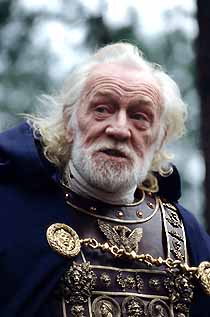
This idea of a noble legacy is portrayed in the movie Gladiator.  The Roman emperor Marcus Aurelius is aging and coming face to face with his own mortality.  In a conversation with General Maximus, played by Russell Crowe, Aurelius shares his feelings about the importance of the legacy he’s about to leave…

“When a man sees his end… he wants to know there was some purpose to his life. How will the world speak my name in years to come? Will I be known as the philosopher? The warrior? The tyrant…? Or will I be the emperor who gave Rome back her true self?”

Aurelius couldn’t bear the thought that he would go down in history as a man of war.  He desired that his memory be one that would impact the people of Rome more positively than any other emperor before him.  But why was this so important?  After all, once he’s dead and gone he won’t have the power to change, the ability to see what history does to his memory nor will he care.  This is especially good for Marcus Aurelius who in the film is later murdered before his plan can take root.  But even so, his desire to leave that legacy was so strong it led him to make decisions which ultimately set into motion his demise.

Maybe it’s because we realize that death ends our earthly influence and so we try to maximize our effectiveness while we can.  But perhaps there’s another reason why this is so important to us.  Leaving a strong legacy is hard wired into men, and that makes sense when you consider how we were made.  When God created us in His image, we were designed to be with Him for eternity.  However, our sin has corrupted God’s plan – turning what was designed to be permanent into something short lived.  And while our bodies are destined to die, something inside of us yearns for something more.  So as we search ourselves we quickly discover that in the earthly realm all that can last beyond our deaths is our legacy.  And so we strive to be the next Abraham Lincoln or the next Bill Gates.  But can that last?  Think about it – what percentage of the world’s population actually know about Marcus Aurelius and his accomplishments as the emperor of Rome.  Yes we can Google him, but does his legacy really mean anything to you?  They often say that people can’t remember who finished #2 in most athletic contests, but the harsh truth is this – in time most people will forget the winner as well.

What has been will be again, what has been done will be done again; there is nothing new under the sun. Is there anything of which one can say, “Look! This is something new”?  It was here already, long ago; it was here before our time. No one remembers the former generations, and even those yet to come will not be remembered by those who follow them. – Ecclesiastes 1:9-11

So does this mean we should abandon our hope of leaving a legacy and simply live our lives with no eye toward the future?  Absolutely not!  Instead, we must turn our focus to something that unlike a legacy can in fact live on for eternity.  And that one thing can only be found in the love of our Heavenly Father.  God is eternal and His love knows no bounds.  What’s more, He has known you from the beginning and as Scripture promises us, He will never leave nor forsake you.  I can amass a fortune and donate it to charity.  I can author hundreds of books.  I can run a business or lead a nation.  I can do anything humanly possible to leave my mark on society but even being friends with every man, woman, and child on Facebook won’t leave as lasting a mark on this world than a simple act of living a life filled with faith in the One who created it, redeemed it, and renews it daily.

May the Lord of all fill our hearts with peace, love and joy now and forever.

Posted in Devotional | Tagged , , , , , , , , , , , , , , , , , , , , , , , , , | 2 Comments

Forgiveness

“Therefore, if anyone is in Christ, he is a new creation; the old has gone, the new has come!” – 2 Corinthians 5:17

 
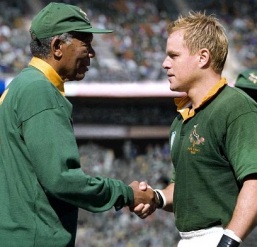
In the movie Invictus, Morgan Freeman portrays former South African President and Nobel Peace Prize Winner Nelson Mandela.  As the nation’s first anti-apartheid president he faced an unprecedented challenge; directing the country into a future that would learn from, but not mirror its past.  For many, the change in leadership signaled a turning of the tides; a reversal of fortune.  People whose voices had been silenced by oppression and fear were now being heard loud and clear, making the message all the more important.  But what Mandela understood above all was that this new voice had to be one of peace, understanding and forgiveness.  This was evident in many decisions he made in the film, but most clearly established in one conversation.

 
Mandela has made the decision to desegregate his personal security staff – a decision that was questioned by the new leader of the bodyguards.  The head of security complained to Mandela who listened to his concerns and then explained his decision using the following words:

 
“Forgiveness liberates the soul.  It removes fear.  That is why it is such a powerful weapon.”

 
As I heard these words, I couldn’t help but think that this is the very sentiment that was displayed by our Savior, Jesus Christ.  Arrested in the middle of the night, accused falsely and on trumped up charges, tried and convicted quickly, sent to Pilate where he was scourged and ultimately condemned, forced to carry a cross to which He was nailed and on which He died.  As He was led to His death, He was whipped, beaten, and scorned.  His death was one of the most horrific and painful ever devised, and yet, in all of this He had the ability to respond to his tormentors with forgiveness.

 
“Jesus said, ‘Father, forgive them, for they do not know what they are doing.’” – Luke 23:34

 
If the story ended there, this would be one of the greatest demonstrations of forgiveness ever given.  But take a moment and consider this – the forgiveness displayed on the cross pales in comparison to the forgiveness found afterward.  Many people, like Mandela, have forgiven those who have wronged them.  Some have even forgiven those who would ultimately be responsible for their own deaths.  But in His resurrection, Christ not only spoke the words of forgiveness but He made forgiveness the reality in which we can now live our lives every day.  He has established for us a new future – one where we have the opportunity to forgive, to be forgiven, and to live unified as a body of believers moving toward an eternity of praising the God whose great love for us made this future possible.

Posted in Devotional | Tagged , , , , , , , , , , , , , , , , , , , , , , , , , , , , , , | Leave a comment

Righteousness Revealed

First, I thank my God through Jesus Christ for you all, that your faith is spoken of throughout the whole world. For God is my witness, whom I serve with my spirit in the gospel of His Son, that without ceasing I make mention of you always in my prayers, making request if, by some means, now at last I may find a way in the will of God to come to you. For I long to see you, that I may impart to you some spiritual gift, so that you may be established— that is, that I may be encouraged together with you by the mutual faith both of you and me. Now I do not want you to be unaware, brethren, that I often planned to come to you (but was hindered until now), that I might have some fruit among you also, just as among the other Gentiles. I am a debtor both to Greeks and to barbarians, both to wise and to unwise. So, as much as is in me, I am ready to preach the gospel to you who are in Rome also. For I am not ashamed of the gospel of Christ, for it is the power of God to salvation for everyone who believes, for the Jew first and also for the Greek. For in it the righteousness of God is revealed from faith to faith; as it is written, “The just shall live by faith.” – Romans 1:8-17

Many Christians are aware of the importance of reading their Bible, just like many do-it-yourselfers are aware of the importance of following a blueprint, many cooks are aware of the importance of following the recipe, and many techno-geeks are aware of the importance of reading the user’s manual.  What all of these people have in common is that the vast majority of them don’t do it.  Sure there are lots of good excuses, and if you work hard enough you can come up with an end result that is adequate.  The construction job will be strong enough, the food will taste good enough, and the computer will operate well enough.  But what about your faith?  Are you a “good enough” type of Christian?  Are you satisfied with knowledge of saving grace but too proud, too cool, too busy or too afraid to live life in the fullness of the righteousness of God?  Are you comfortable because you know enough about God’s grace to get yourself in the door with little more to offer than that?

Why stop there?

Nobody would choose to sleep outside in the cold and rain when offered a warm bed inside.  Nobody would choose to be alone and go hungry when they are invited by friends to a meal.  Nobody would thank their boss for the gesture but refuse to take that paycheck out of guilt.  When people choose to provide us with good gifts, we receive them gladly and we use them to the fullest.  Why then would we choose to take what is without question the greatest gift we have been given and leave it sitting on the side, denying ourselves access to the greatest joy, comfort, and peace that we can possibly imagine?

In verse 17, Paul is clear when it comes to describing the benefits we receive from God through the gospel.  A righteousness from God is revealed.  There is no other place where this can be found, no other way to get it.  It is stored up for us in the Word and is revealed to us by God through the Word.  God is giving us a gift of great value, and He is telling us the exactly where we can find it.  Once that righteousness is revealed to us, we are able to live our lives in His abundant righteousness as He has provided it for us.  Not a bad deal really – that is if we do our part and get into His Word.

Posted in Devotional | Tagged , , , , , , , , , , , , , , , , , , , , , , , , , | 1 Comment

No Greater Love

Greater love has no one than this, than to lay down one’s life for his friends. – John 15:13

Mel Gibson’s The Passion of the Christ is the most graphic depiction of the events of Maundy Thursday and Good Friday ever filmed. For years movies and television shows telling Jesus’ story limited their portrayals of the violence of Jesus’ death. “Passion” left nothing to the imagination. Utilizing modern cinematic special effects, Gibson gives us an up-close look at the physical agony that Christ experienced.

I remember the first time I saw the film in the theater. I understood the physicality of crucifixion, but seeing it reenacted on the screen was an eye-opening experience. I’ve seen the movie several times since and still marvel at what Jesus endured on my behalf. But it was during my last viewing of the film that I noticed something that gave me a renewed understanding of what Jesus did that day at Calvary.

Having been condemned by Pilate, Jesus was led out to be executed. After Jesus drops His cross, the soldiers grab Him and violently strip off his cloak, knocking him to the ground. He lies there for a moment, catching His breath, summoning His strength. It is here where the most amazing thing happens. Jesus picks himself up off the ground and crawls toward His cross.

I couldn’t believe what I was seeing. Who would do this? I realize that this is a motion picture and not an accurate account of every detail shared in the Gospels. I also understand that He’s in no condition to run or fight after hours of being tortured. But to see the Son of God, battered and beaten, lying on the ground, exerting His last bit of strength to move toward His death was an amazing revelation to me. You might expect Him to just lie there, forcing the soldiers to do their jobs while He hung onto life for as long as He could. But the way this scene was presented shows us the most important of truths, reminding us of the purpose for which He had been sent.

So why did He do it? Why move toward the suffering and death that awaited Him? It was love. It was love that brought Him to earth, to be a man born in a stable. Love compelled Him to feed the hungry and to heal the sick. And now, in the most significant moment in human history, it was love that led him to die on a cross. He wasn’t forced to do this. There was no order given. It wasn’t a debt that He owed, just one that He chose to pay. It was His choice, and it was a choice rooted in a love far greater than any other.

As our Lenten journey takes us to Calvary followed by Easter Sunday’s empty tomb, let us remember that our salvation comes from the love of God for us shown through the sacrifice made by Jesus Christ. May we offer our deepest thanks to God for His grace, and let us share His story through our thoughts, words and deeds; now and always.

Posted in Devotional | Tagged , , , , , , , , , , , , , , , , , , , , , , , , | 3 Comments

Minute by Minute

You have searched me, LORD, and you know me. You know when I sit and when I rise; you perceive my thoughts from afar. You discern my going out and my lying down; you are familiar with all my ways. Before a word is on my tongue you, LORD, know it completely. You hem me in behind and before, and you lay your hand upon me. Such knowledge is too wonderful for me, too lofty for me to attain. – Psalm 139:1-6

 
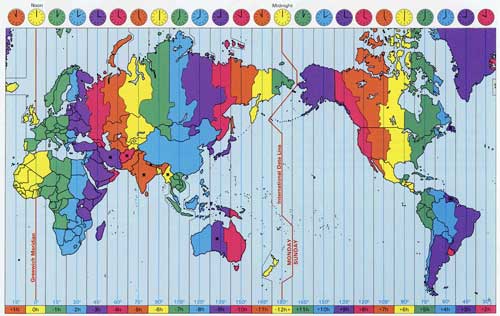
One of the most interesting and sometimes challenging things to teach younger students is the concept of the time zones.  Because we are most familiar with our immediate surroundings, we tend to assume that everyone else is experiencing the same things we are.  Globalization has also contributed to the difficulty.  Because the media and the Internet provide us with immediate access to nearly every corner of the world, we assume once again that things are happening based on our own timeframe and according to our own perspectives.  It’s once we start traveling that we begin to see the differences.  The Today Show on NBC airs from 7:00 a.m. to 9:00 a.m. in New York City, which means that it has been off the air for an hour before it begins in Los Angeles.    I enjoy talking with a friend of mine in London when I catch him on Facebook or Skype.  If I stay up late I can sometimes catch him waking up early (yes, he has kids).  In these circumstances I will often ask him how tomorrow is going, is it worth waking up for, or I’ll simply leave him in charge of the planet until I wake up later (and I can usually blame him for most of the mishaps that occur).

 
I may be overthinking it, but the continual movement of time impresses me.  Think about it: is there ever a time when the sun is not rising or setting?  Someone is always waking up.  Someone is always heading to bed.  The work day never stops starting and as the song points out – it’s always 5:00 somewhere!  Midday in Washington DC means end of the morning rush in Seattle, dinner time in Paris, and Hong Kong is in bed getting ready to start tomorrow.  So when you stop and think about it, everything is different.

 
Almost…

 
There is one part of the clock that is common in most every time zone.  The hour hand changes with every time zone you enter, but the minutes hand remains the same.  10:22 in Miami is 9:22 in Chicago, 8:22 in Denver, and 7:22 in San Francisco.  And so the bigger time block (hours) are all different but the smaller time measurements (minutes) are all the same.  And it is here, in this commonality that I found a most interesting parallel.

 
In life, many of us gear up for the major events that happen.  We all get the opportunities to deal with gains and losses, births and deaths, victories and defeats.  Major life events occur on a continual basis throughout the world.  In the time it takes you to read this blog, literally hundreds of people will have been born, been hired or fired from a job, fell in love or separated from a loved one, made or lost a million dollars, discovered or invented something, retired, and/or died.  These are major life events and they are happening all the time.  But even more than the big events, think about the smaller things that every man, woman and child on our planet share.  Literally millions of people are currently eating a meal, listening to a song, driving a car, hugging someone, feeling sad, and/or having a good day.  The human experience is shared, but the commonality is most prevalent in the little things that happen minute by minute. 

 
We live our lives heavily focused on the hours.  Planners and calendars list our days by the hour (and often only from 8:00 – 6:00), but when’s the last time life happened at the top of the hour?  Thankfully we have a God that knows and connects with us on a minute by minute basis.  We often ask people we care about to tell us about their day.  How deeply would you need to love someone to want to hear a minute by minute account of their thoughts, feelings, and responses to the events of their day?  It is at our most basic levels where God’s interest in us lies.  His love is comprehensive.  His mercy is complete.  Because of His great love for us, we can move forward in boldness, confident that our God is not merely 24/7, but with us 1,440 minutes a day.

Posted in Devotional | Tagged , , , , , , , , , , , , , , , , , , , , , , | 1 Comment

Free to be Free

I have chosen the way of truth; I have set my heart on your laws. I hold fast to your statutes, O LORD; do not let me be put to shame. I run in the path of your commands, for you have set my heart free. – Psalm 119:30-32

For non-believers, this passage may have an inconsistent feel.  Following someone’s commands doesn’t sound like freedom.  To the world, freedom is that “I can do whatever I want whenever I want to” approach that so many people seek.  On the surface that sounds good.  We want freedom in our schedules, financial freedom; the freedom to decide what’s best for us today and into the future.  The only problem with that reasoning is – we simply aren’t in a position to make this happen.

In order to understand what freedom is, we should probably start by looking at what freedom is not.  Freedom does not give us the opportunity to do anything we want.  Americans have freedom of speech, but this doesn’t give us the right to threaten one another.  Instead, we have the responsibility to protect and defend our freedoms through respecting the laws of our nation, the rights of our neighbors, and the Word of our God.

It is only through God – the way of truth, that we will ever know true freedom.  His laws and precepts guide us to our destinies so that we might know the fullness of the blessings He wishes to manifest in our lives.  It is through our diligent pursuit of Him and our desires to follow His will we will find the fulfillment of our destinies.  So it demonstrates a most interesting contradiction: freedom comes through submission.

Posted in Devotional | Tagged , , , , , , , , , , , , , , , , , , | 1 Comment

Attention to Detail

“The LORD bless you, my daughter,” he replied. “This kindness is greater than that which you showed earlier: You have not run after the younger men, whether rich or poor. And now, my daughter, don’t be afraid. I will do for you all you ask. All my fellow townsmen know that you are a woman of noble character. Although it is true that I am near of kin, there is a kinsman-redeemer nearer than I. Stay here for the night, and in the morning if he wants to redeem, good; let him redeem. But if he is not willing, as surely as the LORD lives I will do it. Lie here until morning.”  So she lay at his feet until morning, but got up before anyone could be recognized; and he said, “Don’t let it be known that a woman came to the threshing floor.”  He also said, “Bring me the shawl you are wearing and hold it out.” When she did so, he poured into it six measures of barley and put it on her. Then he went back to town. – Ruth 3:10-15

 
Boaz is an awesome example of how a man ought to treat a woman of virtue.  He begins by not only recognizing this trait in Ruth, but by stating it to her.  Again, the power of the spoken word is evident.  It serves her well to hear him identify her as noble.  It also puts him into a proper position of respecting her, sowing a necessary level of respect into her that encourages and supports.

 
Next, he cares for her every need – those which are obvious and simple as well as in ways that go beyond what would be expected.  As a kinsman-redeemer, he allows her to lay at his feet, covered by his garment.  He cares for her immediate need for a warm, safe place to rest.  He cares for her reputation by making sure people do not know she was there.  He knows her actions were noble and actively works to protect her from slander.  He cares for her physical needs by providing her with food for herself and for Naomi.  Finally, he promises her that he would go that day to the relative who is closer to her and legally eligible to marry her to ask his intentions.  If the relative declines, he vows to her that he will take her as his wife.  This shows reverence to God and His law.  His love for her has taken root, but He chooses to love her according to God’s plan.

 
How wonderful it is to see how even basic human emotions and interactions are further blessed by obedience to the word of the Lord.  There is nothing we need fear in life, nothing that can disrupt the will of the Father in our lives.  All we need do is turn to Him, trust in Him, and thankfully receive from Him the fullness of the gifts He brings into our lives.  The rest is provided from His throne.  However, for many this simple truth is complicated by mistakes and decisions based on selfishness, impatience and fear.  We think we know what God’s will is instead of seeking His voice through the word and in prayer.  We abandon His plan by setting of on a path of our own choosing.  But because He is a God of love, He gives us the opportunity to seek forgiveness and renewal in His promises through grace and forgiveness found in the death and resurrection of Christ.

 
If God will take care of these things, surely every concern, issue, and circumstance will be dealt with, leaving us secure in the power of the Lord our God.  And so again, I start my day thankful for the blessing of loved ones in my life.  I pray that God will lift you up to accomplish all you have targeted and more.  I pray that you will have peace, safety, and security in His promises spoken over you.  Be blessed, filled with the power of the anointing God has placed upon you.  Know His love surrounds you today, and let it move you to greater levels within His kingdom.

Posted in Devotional | Tagged , , , , , , , , , , , , , , , , , , , , , , , , , , , | Leave a comment

Indecision in Division

Then they brought him a demon-possessed man who was blind and mute, and Jesus healed him, so that he could both talk and see. All the people were astonished and said, “Could this be the Son of David?” But when the Pharisees heard this, they said, “It is only by Beelzebul, the prince of demons, that this fellow drives out demons.” Jesus knew their thoughts and said to them, “Every kingdom divided against itself will be ruined, and every city or household divided against itself will not stand. If Satan drives out Satan, he is divided against himself. How then can his kingdom stand? And if I drive out demons by Beelzebul, by whom do your people drive them out? So then, they will be your judges. But if it is by the Spirit of God that I drive out demons, then the kingdom of God has come upon you. “Or again, how can anyone enter a strong man’s house and carry off his possessions unless he first ties up the strong man? Then he can plunder his house. “Whoever is not with me is against me, and whoever does not gather with me scatters. And so I tell you, every kind of sin and slander can be forgiven, but blasphemy against the Spirit will not be forgiven. Anyone who speaks a word against the Son of Man will be forgiven, but anyone who speaks against the Holy Spirit will not be forgiven, either in this age or in the age to come. – Matthew 12:22-32

 
How clearly do Christ’s words in this passage apply to our world today?  “Every kingdom divided against itself will be ruined, and every city or household divided against itself will not stand.”

 
It seems that the word to best describe the beginning of 2011 would be division.  Political unrest in the Middle East coupled with state governments making difficult decisions has brought a wave of divisiveness into the lives of many.  Discussion and debate are not bad things; conflict is a healthy and necessary part of learning and progress.  But a conflict where winners are celebrated at the expense of those who have lost leaves us in a far different and more dangerous place.  As a country, we’ve gone that route before – The Civil War.  Please understand that I am not suggesting that we are on the brink of revolution, but by looking back at our history and at the words of Christ, I think a valuable lesson can be learned.

 
The major goal for President Lincoln throughout the war was to maintain and reestablish the unity of the nation.  Lincoln wanted nothing more than to gain back the half of the country that had seceded from the union.  His second goal was to keep unity among the states that remained in the union.  So Lincoln understood the importance of unity.  Where did he gain this insight?  Perhaps it was impressed upon him by the election that landed him in this crisis in the first place.  The major reason the history books tell about President Abraham Lincoln and not President Stephen Douglas was because of a lack of unity among the Democratic Party.  In the election of 1860, the Democrats divided their party among three candidates:  Douglas, John Breckenridge, and John Bell.  With their vote split, the Republican candidate from Illinois was able to claim victory: A united Republican Party defeated the divided Democrats.

 
Unity is essential to any organization.  The lack of unity will fracture any group or organization.  When the husband and the wife are not united, the family suffers.  When the players and the coaches are not united, the team is defeated.  When the workers and the managers are not united, the business loses money.  So when the body of Christ is not united, what do you think that result will be?

 
Jesus points out to the Pharisees the illogical nature of their claims.  “If Satan drives out Satan, he is divided against himself.  How then can his kingdom stand?”  But if this is true, why then do we as a body of believers convince ourselves that we can live in relative peace and harmony as a church even when we stand in opposition to one another?  There is no benefit earned by disharmony.  There is nothing gained by factions.  The only winner in this situation is Satan.  He has been given the greatest gift he can receive – a body of believers who need no special attention on his part because they have divided themselves into inactivity and ineffectiveness.

 
So how does a body of believers come back to a place of harmony after living in division?  They must find commonality in the one thing that is greater than any personal issues that have created the splits of the past.  That one unifying element is Christ: His words, life, death and resurrection.  Matthew 6:33 implores us to seek first the Kingdom of God.  Not later, not after checking our other options, not when it is best suited to meet our needs, but first.  If the action aligns with God’s Word, do it.  If not, then don’t.

 
So if what this says is true, does that mean that we should find a Biblical basis for the things we do?  Yes.  So if it does not root itself in the Word of God and we cannot connect it into the will of God for His church, we should avoid doing it, even if many of us think that it’s fun?  Yes.  Isn’t that closed minded and lacking a vision of the big picture?  No.  We are a church after all.  I am not suggesting that we only allow the perfect into the church (attendance would drop drastically).  But as a body of believers here on earth, we will do amazing things in the name of Jesus Christ when we aspire to become aligned with the will of God. 

 
May God continue to bless us now and always as we seek His will to solve our ills by the power of His glorious name.

Posted in Devotional | Tagged , , , , , , , , , , , , , , , , , , , , , , , , , | 1 Comment

Abide with Me

I am the true vine, and my Father is the gardener. He cuts off every branch in me that bears no fruit, while every branch that does bear fruit he prunes so that it will be even more fruitful. You are already clean because of the word I have spoken to you. Remain in me, as I also remain in you. No branch can bear fruit by itself; it must remain in the vine. Neither can you bear fruit unless you remain in me. “I am the vine; you are the branches. If you remain in me and I in you, you will bear much fruit; apart from me you can do nothing. If you do not remain in me, you are like a branch that is thrown away and withers; such branches are picked up, thrown into the fire and burned. If you remain in me and my words remain in you, ask whatever you wish, and it will be done for you. This is to my Father’s glory, that you bear much fruit, showing yourselves to be my disciples.” – John 15:1-8

 
One of my fondest childhood memories growing up as a student in a Lutheran school was attending Lenten services on Wednesdays.  There were many things I enjoyed about these services, but in particular I liked them because we always finished the service with one of my favorite hymns: Abide with Me, and in particular, verse 8.

 
Hold Thou Thy cross before my closing eyes;
Shine through the gloom and point me to the skies.
Heaven’s morning breaks, and earth’s vain shadows flee;
In life, in death, O Lord, abide with me.

 
To abide means to dwell or to remain.  Some may think that this merely means showing up and sticking around for awhile.  That’s a good beginning, but there’s more to it than that.  Consider a fruit tree.  Before it will produce a harvest, the tree must first mature.  You’re not going to plant an apple seed in the spring and eat apples in the fall.  So what does it take to bring the tree to maturity?  It must remain firmly rooted into the soil, where it will sustain itself with water and nutrients.  Over time, the tree must be cultivated, pruned, fertilized, and watered.  After review, this seems to be a lot of work.  After all, apple trees existed for a very long time before the first orchard was established.  So why do we bother?  It’s to increase our yield.  Simply leaving the tree by itself may not kill it, but it will not produce a maximized harvest. 

 
This same analogy can be applied to our faith life.  Knowing the Word is not a bad thing, but knowing the Word and living it are very different.  By understanding and actively living our lives in alignment with the Word of God, we give ourselves the best opportunity to grow in our faith. It is a mature faith, like a mature tree, that will produce a maximum kingdom harvest.  And how do we do that?  Abide in Him.

 
“If you abide in me, and my words abide in you, ask for whatever you wish, and it will be done for you.”  Realize that these words from John 15:7 are not figurative, nor are they intended just to make you feel good.  This is Christ promising us a blessing for our obedience.  It is God’s will that we abide in Him, that we rely upon His teaching, and that we seek His guidance for all things in our lives.  When we do so, God will bestow upon us the blessings that He has waiting for us.  Because when we trust God enough to abide in Him completely, He will do wonderful things in our lives that will cause much fruit to be produced.  This promise is found later in John 15:16 as Christ reminds us that, “You did not choose me, but I chose you and appointed you that you should go and bear fruit and that your fruit should abide, so that whatever you ask the Father in my name, he may give it to you.”

 
Consider yourself a seed planted by God.  He chose the time and the place.  He provides the elements needed to be healthy.  He prunes and cultivates us to help us grow strong.  All of this to ensure the harvest will be abundant and of the highest quality.  What in turn does the seed need to do?  It must only stay put.  To remain in place. 

 
To abide in Him.

Posted in Devotional | Tagged , , , , , , , , , , , , , , , , , , , , | 1 Comment